Gas vs Electric Garage Heater: Which Should You Buy?
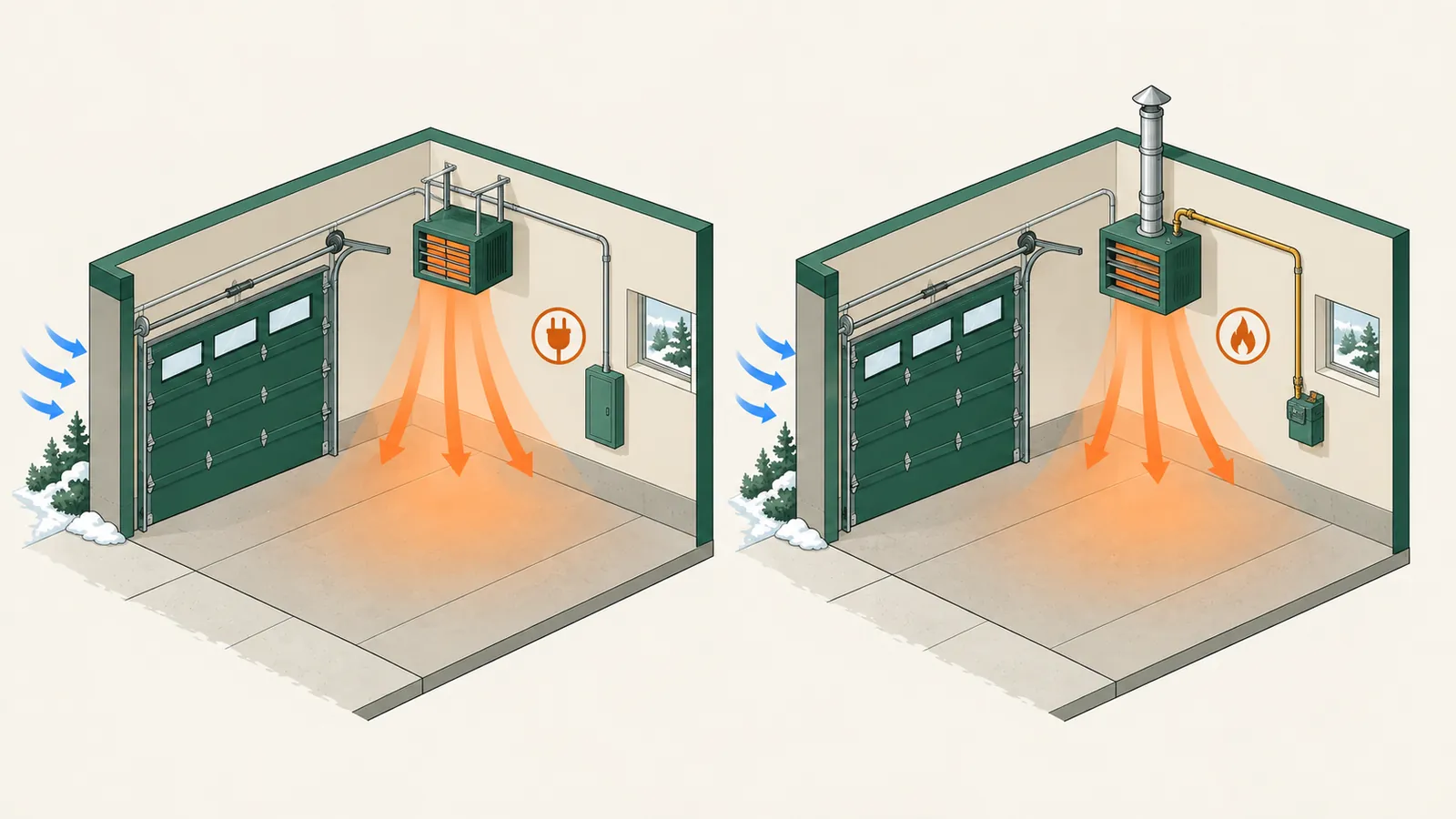
A gas garage heater costs less to run, and an electric one costs less to install. For a 24 × 24 garage heated 4 hours a day, 5 days a week, gas runs about $97 a winter and electric about $266. Electric is the cheaper buy for a few hours a week. Gas pulls ahead when you heat for long hours, and sooner if gas is already piped to the garage.
Enter your own garage below to see where your numbers land.
Gas vs electric for your garage
24,500 BTU/hr, 4 h a day, 5 days a week, heating half that time. Prices are the 2025 U.S. averages unless you change them in the calculator.
Ordered by fuel cost per winter.
- 1
Natural gas unit heater (vented)
$97 per winter
One 45,000 BTU/hr input unit
- Installed
- $1,500–$6,000New gas line and vent. Same model as our installation cost page.
- Install work
- Gas line, vent and a licensed installer
- Good for
- Long hours and big or cold garages
- Watch out
- Installation can cost more than years of fuel if there is no line nearby
- 2
Propane unit heater (vented)
$183 per winter
One 45,000 BTU/hr input unit
- Installed
- $1,600–$7,000New tank setup and vent. Same model as our installation cost page.
- Install work
- Tank, regulator, line, vent and an installer
- Good for
- Homes without natural gas that heat for long hours
- Watch out
- Fuel costs more than natural gas, and the tank needs deliveries
- 3
240 V electric unit heater
$266 per winter
One 7,500 W unit covers it
- Installed
- $750–$2,250New 240 V circuit. Same model as our installation cost page.
- Install work
- Electrician and a dedicated 240 V circuit
- Good for
- Small to mid garages, short sessions, no gas
- Watch out
- Highest running cost per BTU at average U.S. prices
Ventless heaters are left out of the ranking. Why ventless heaters are left out.
Gas vs electric, side by side
Here is the default two-car garage, 24,500 BTU/hr, heated 4 hours a day, 5 days a week for a 5-month winter. The heater runs about half the time you are out there.
| Heater | Per winter | Installed | Install work | Safety | Best fit |
|---|---|---|---|---|---|
| 240 V electric | $266 | $750 to $2,250 | Electrician, dedicated circuit | No combustion; circuit and clearances | Short sessions, no gas |
| Natural gas, line at garage | $97 | $1,000 to $4,000 | Gas installer, new vent | Vent outside, CO alarm | Long hours, big garages |
| Natural gas, new line | $97 | $1,500 to $6,000 | Gas line, vent, installer | Vent outside, CO alarm | Daily use for many years |
| Propane (no gas service) | $183 | $1,600 to $7,000 | Tank, line, vent, installer | Vent outside, CO alarm | Long hours without gas |
Running cost: gas wins by a lot
Electric resistance heat turns all of the electricity it uses into heat, so efficiency is not the problem. Price is. At average 2025 U.S. prices, a million BTU of delivered heat costs about $50.70 from electricity, $34.90 from propane and $18.50 from natural gas, even after the gas heater loses 20% up the vent.
That makes electric about 2.7 times the price of gas for the same warmth. In our default garage the gap is $169 a winter. Double your hours and the gap doubles too.
Your own rates matter more than the national average. If your electricity is cheap or your gas is expensive, run the cost to run a garage heater numbers with your bill before you decide.
Installation: electric wins, sometimes by thousands
A 240 V electric heater needs a dedicated circuit and an electrician. Our model puts that job at $750 to $2,250 with the heater included. Permits and any panel upgrade come on top of that.
A vented gas heater needs a gas supply, a vent through the wall or roof and a qualified installer. With gas already piped to the garage, our model shows $1,000 to $4,000. Running a new line raises it to $1,500 to $6,000. The garage heater installation cost page breaks those ranges down item by item.
How many hours before gas pays off
Gas costs more upfront and less every hour, so the question is how many hours you heat. Using the middle of each installed range, gas with a line at the garage costs $1,000 more to install than electric. It earns that back over three winters if you heat about 39 hours a week, or over ten winters at about 12 hours a week.
A new gas line moves the bar a long way. The extra installation grows to $2,250, and break-even becomes about 89 hours a week over three winters or 27 over ten. These figures are for our default garage. A bigger or colder garage reaches break-even sooner.
Which one should you choose?
Choose electric if
- You heat the garage a few hours a week, for projects or workouts.
- There is no gas line near the garage, or you rent and cannot add one.
- Your garage needs no more than one 7,500 W heater can cover (our default needs about 7,200 W), and your panel has room for a 40 A circuit.
Choose gas if
- You heat for long stretches most days, or keep the garage above freezing all winter.
- Gas is already at the garage, which cuts the installed cost to $1,000 to $4,000 in our model.
- The garage needs more than about 10,000 W, where one gas unit is simpler than several electric circuits.
No natural gas at the house? Propane is the vented alternative, at about $183 a winter in our default case. Still unsure? The best way to heat a garage guide ranks all six options, including mini splits and infrared, and the electric garage heater and natural gas garage heater guides go deeper on each.
Safety differences
An electric heater burns nothing, so there is no exhaust to manage. The risks are an undersized circuit and things too close to the heater. Follow the clearances in the manual and let an electrician size the circuit.
A gas heater makes combustion gases. A vented unit sends them outside, and a CO alarm in the home is cheap insurance; the CPSC lists headache, dizziness, nausea and confusion as warning signs. Gas appliances in a garage also need their ignition source at least 18 inches above the floor unless the appliance is listed as flammable-vapor-ignition resistant (IRC G2408.2).
Gas vs electric questions
Is it cheaper to heat a garage with gas or electric?
Gas is cheaper to run. At 2025 U.S. average prices, a million BTU of delivered heat costs about $18.50 from natural gas and $50.70 from electric resistance heat. Electric is cheaper to install, so it often wins for garages you only heat a few hours a week.
Which heats a garage faster, gas or electric?
The one with more output, whatever the fuel. A common 45,000 BTU/hr input gas unit delivers about 36,000 BTU/hr at 80% efficiency, while a 7,500 W electric heater delivers about 25,590 BTU/hr. In our default garage, both cover the 24,500 BTU/hr load, and the gas unit has more headroom for warm-up.
Is a gas garage heater worth the installation cost?
It depends on hours. With a gas line already at the garage, gas pays back its extra installation cost over three winters once you heat about 39 hours a week in our default case, or about 12 hours a week over ten winters. Without a line, the bar is much higher.
Do gas garage heaters need to be vented?
A vented unit heater sends its exhaust outside, which is what you want in a closed garage. Unvented gas and kerosene heaters release carbon monoxide, nitrogen dioxide and particles into the room, according to the EPA. Read the ventless heater safety guide.
Does an electric garage heater need its own circuit?
A 240 V garage heater does. Fixed electric space heating is sized at 125% of its load under the electrical code, so a 7,500 W heater drawing about 31.3 A points to a 40 A dedicated circuit in our example. Your electrician confirms the breaker and wire for your panel.
Sources
Checked October 1, 2026. Page dates are the publisher's own.
- HomeAdvisor, Garage Heater Installation Cost (June 19, 2026)
- HomeAdvisor, Cost to Install a Dedicated Circuit (June 19, 2026)
- Fixr, Gas Line Installation Cost (Aug 29, 2025)
- DOE Energy Saver, Electric Resistance Heating (archived) (captured Jan 1, 2026)
- EPA, Sources of Combustion Products (Dec 17, 2025)
- CPSC, Carbon Monoxide Information Center (undated)
- UpCodes, IRC 2024 Chapter 24 (G2408.2) (2024 IRC)
- NEC 424.4(B) as quoted by Fast Trax (undated)
Sizes and costs come from the same model as the garage heater calculator. Defaults: 24 × 24 × 8 ft, average insulation, 20°F outside, 60°F inside, 2025 U.S. average prices.