Natural Gas Garage Heaters: Size, Installation and Running Cost
A typical 24 × 24 two-car garage needs about 24,500 BTU/hr of heat, which means a natural gas unit heater rated around 45,000 BTU/hr input. Used 6 hours a day with the heater running about half that time, it costs about $41 a month at 2025 average gas prices.
Gas heaters are labeled by the fuel they burn, not the heat they deliver. That one detail trips up more buyers than anything else, so the sizes below are all input ratings.
What size natural gas heater does your garage need?
Start with the heat your garage loses, then divide by the heater's efficiency. We assume 80%, so a 30,000 BTU/hr heater delivers about 24,000 BTU/hr. That is why a 24 × 24 garage needing 24,500 BTU/hr lands on a 45,000 BTU/hr unit instead of a 30,000.
| Garage | Poor | Average | Good | Excellent |
|---|---|---|---|---|
| 1-car 12 × 20 × 8 ft | 30,000 15,500 out | 30,000 10,000 out | 30,000 7,500 out | 30,000 6,000 out |
| 2-car 24 × 24 × 8 ft | 50,000 37,000 out | 45,000 24,500 out | 30,000 18,500 out | 30,000 14,500 out |
| 3-car 32 × 24 × 8 ft | 75,000 49,000 out | 45,000 32,500 out | 45,000 24,500 out | 30,000 19,500 out |
Most one-car garages and any well-insulated two-car garage fit a 30,000 BTU garage heater. An average 3-car garage needs about 32,500 BTU/hr delivered, so a 45,000 BTU/hr unit covers it. A cold, drafty two-car garage, or a three-car garage with tall ceilings, moves into 50,000 BTU garage heater territory or above.
Buying one size up is fine and shortens warm-up from a cold start. Doubling the size is not: an oversized heater short-cycles, costs more to buy and does not make the garage any warmer once it is up to temperature.
Ceiling height matters as much as floor area, and so does your winter low. Use the calculator above with your own numbers; it reads your ZIP code for a local cold-weather estimate.
Unit heater or infrared tube?
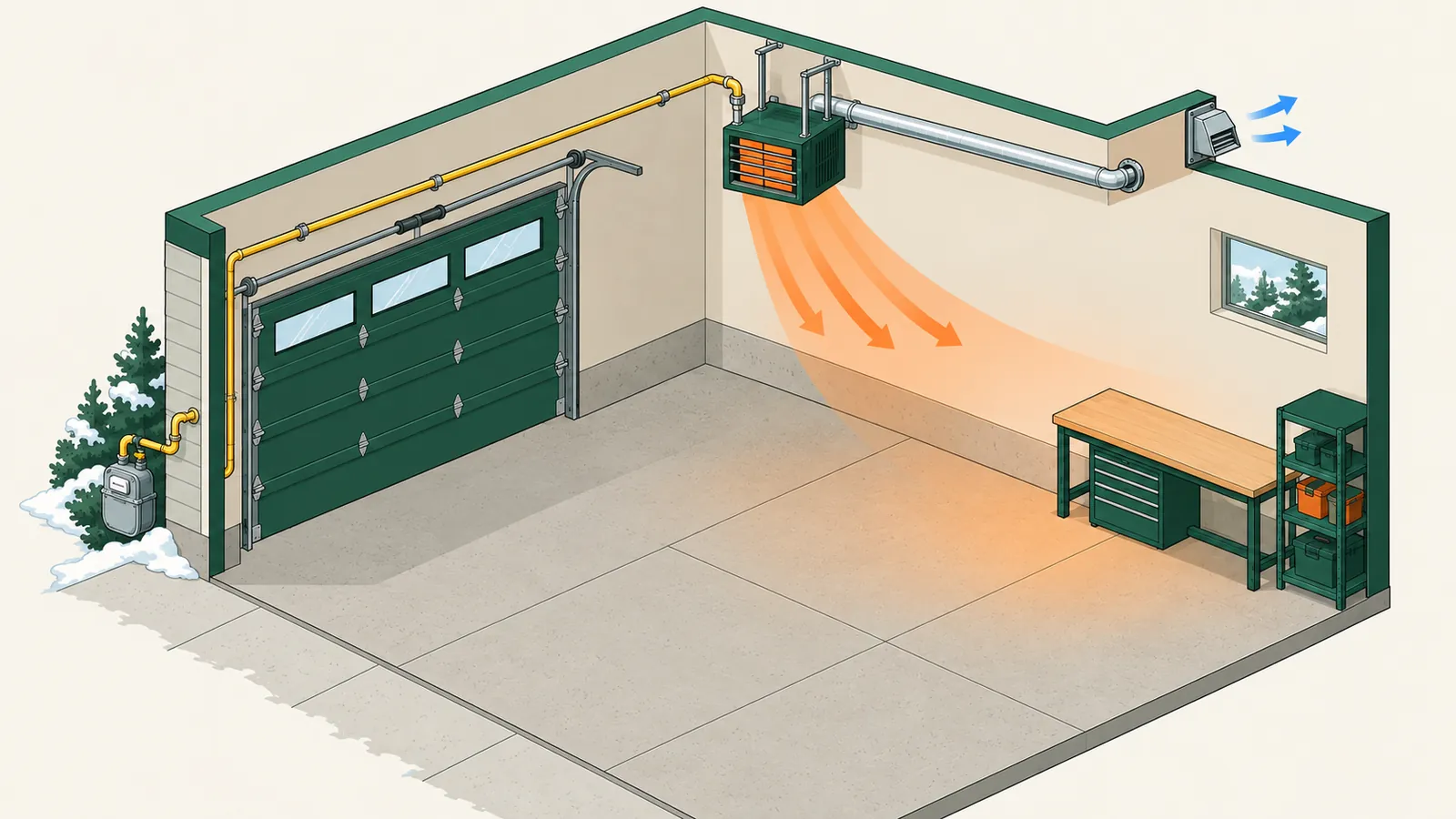
A forced-air unit heater hangs from the ceiling, burns gas inside a sealed heat exchanger and blows warm air across the garage. It brings the whole space up to temperature and recovers quickly after you open the door. For most residential garages up to three bays, this is the standard choice.
An infrared tube heater runs a long, hot tube near the ceiling with a reflector above it. It warms the floor, the car and you, rather than the air. In a tall garage or a shop where warm air collects at the roof, that can feel comfortable at a lower air temperature. Tubes need more mounting height and clearance, and Family Handyman notes that most forced-air units cost about half as much as low-intensity tube heaters.
A simple rule: if you work all over the garage, buy a unit heater. If you stand in one spot under a high ceiling, look at infrared.
Ceiling mount and thermostat
Most garage unit heaters hang from the ceiling or a wall bracket, up out of the way of car doors and ladders. A common layout puts the heater in a corner and aims it along the longest wall, so warm air sweeps the space instead of blowing straight at the garage door.
Put the thermostat on an inside wall at about chest height, out of the heater's air stream and away from the door, so it reads the room rather than a draft. Many unit heaters ship without one, and the manual lists which kind it accepts.
What installing a gas garage heater involves
Four things have to be right: a gas supply sized for the heater, a vent approved for that model, electrical power, and clearances to anything that can burn. Our installation model puts a gas unit heater with a new vent at $1,000 to $4,000 when a gas line is already at the garage, $1,350 to $4,800 for a short extension, and $1,500 to $6,000 with a new line from the meter.
Gas line
The line is often the biggest variable. HomeAdvisor reports most gas pipe jobs at $271 to $936, and $15 to $30 per linear foot for a new line. Fixr puts typical gas line installation at $500 to $2,000. A long run to a detached garage, or a meter that needs upgrading, can go well past those ranges.
Venting and power
Every vented heater needs a flue or sidewall vent that the manufacturer approves for that exact model, with its own length and termination limits. Most powered-vent unit heaters also need a 120 V outlet or circuit for the fan and ignition; check the manual before you pick a mounting spot.
Clearances and height
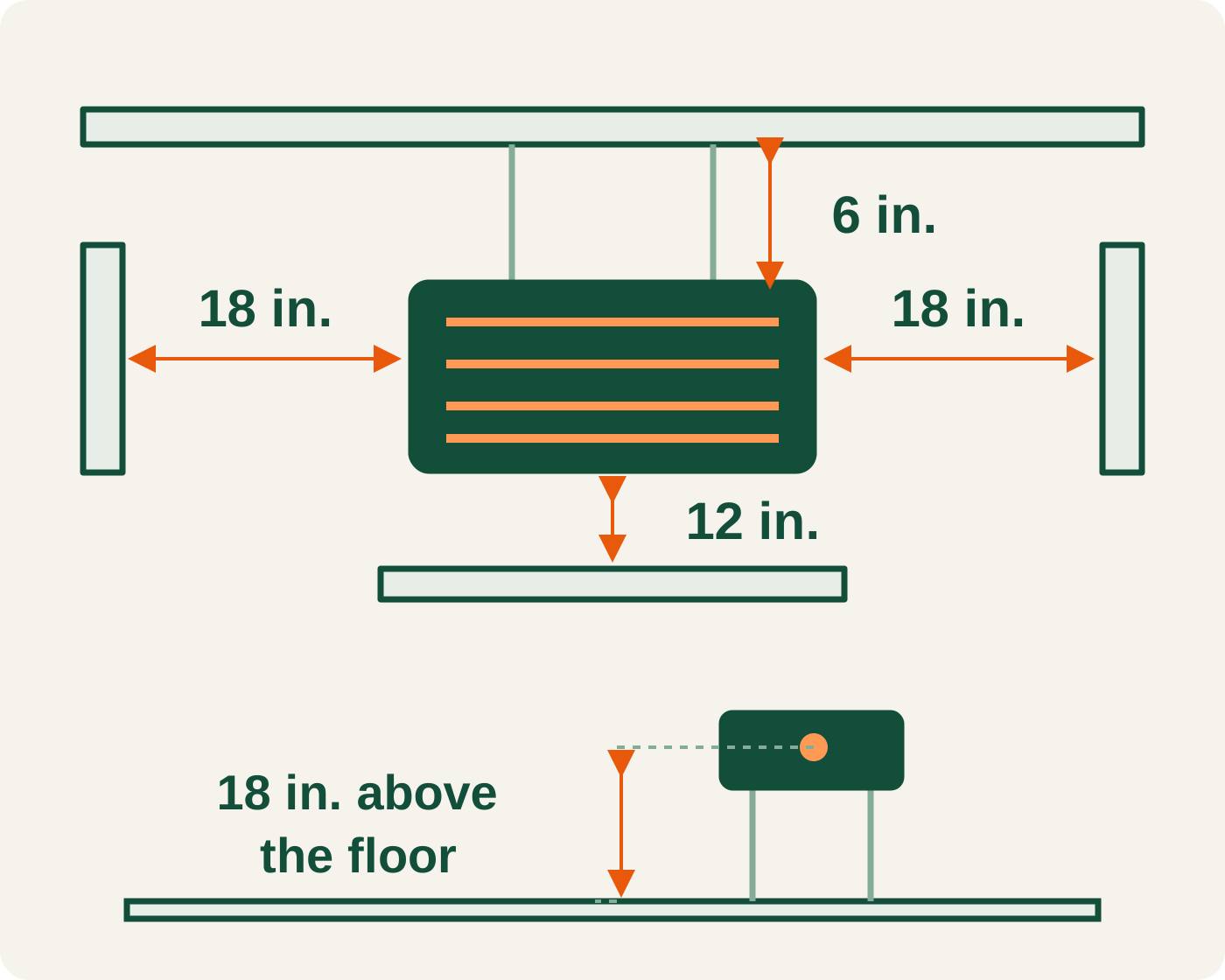
The model residential code requires gas appliances in garages to have their ignition source at least 18 inches above the floor, unless the appliance is listed as flammable-vapor-ignition resistant (IRC G2408.2). For suspended unit heaters, the code's general clearances to combustible material are 18 inches at the sides, 12 below and 6 above (IRC G2444.4). A heater listed for different clearances is installed to its label and manual instead, which can allow less in one direction and require more in another, plus room for service. The 18-inch ignition rule is about height above the floor, not how high to hang the heater; the manual sets the mounting height.
Rules differ by town, but gas work usually needs a permit and a licensed installer. Check with your local building department. Our garage heater installation cost page breaks the job into parts you can price.
How much gas it uses and what it costs
Gas is billed in therms, and one therm is 100,000 BTU (EIA). A 45,000 BTU/hr heater burning at full fire uses 0.45 therms an hour, about $0.67 at the 2025 U.S. average of $1.48 per therm.
It will not burn at full fire all the time. A thermostat cycles the heater, and the cost follows the heat the garage actually loses. Assuming the heater runs half the time you are using the garage, our 24 × 24 example costs about $41 a month at 6 hours a day, 7 days a week, and about $19 at 4 hours a day, 5 days a week.
Efficiency moves the bill a little. One manufacturer lists up to 83% thermal efficiency for its power-vented unit heaters, up to 82% for separated-combustion models and up to 97% for condensing models. Our 80% assumption is slightly conservative for a standard unit. The cost to run a garage heater page lets you change the price, hours and runtime.
Natural gas or propane?
If natural gas reaches your house, it is almost always the cheaper fuel. At 2025 average prices, a million delivered BTU costs about $18.50 on natural gas, $34.90 on propane and $50.70 on electric resistance heat. For the 24 × 24 example that is $41 a month on gas against $77 on propane.
Propane makes sense when there is no gas service, or the garage is far from the meter and a tank is easier to place. Heaters for the two fuels look alike but are built for one or the other, so buy the version that matches your supply. The propane garage heater guide covers tanks and fuel use, and gas vs electric garage heater compares both against electric for your garage.
Questions about natural gas garage heaters
How many BTU natural gas heater for a 2-car garage?
About 45,000 BTU/hr input for a 24 x 24 x 8 ft garage with average insulation and a 40°F temperature rise. That delivers at least the 24,500 BTU/hr the garage needs at 80% efficiency. A drafty, uninsulated two-car garage needs about 50,000 BTU/hr input.
Does a natural gas garage heater need to be vented?
A standard gas unit heater is vented: it sends its exhaust outside through a flue or a sidewall vent. Unvented heaters put carbon monoxide and water vapor into the garage, and some states and towns ban them. For a garage you work in, plan on a vented unit. Read the ventless heater safety guide.
How much does it cost to run a natural gas garage heater?
For a 24 x 24 garage heated 6 hours a day, about $41 a month at the 2025 U.S. average of $1.48 per therm. At 4 hours a day, 5 days a week, it drops to about $19. Both assume the heater runs half the time you are out there.
Do I need a permit to install a gas garage heater?
Rules differ by town, but gas piping and a new vent usually need a permit and a licensed installer. Check with your local building department before work starts. A good installer will pull the permit as part of the job.
Sources
Checked October 1, 2026. Page dates are the publisher's own.
- EIA, British thermal units (Btu) (undated) · 1 therm = 100,000 Btu
- HomeAdvisor, Install or Repair Gas Pipes (June 20, 2026)
- Fixr, Gas Line Installation Cost (Aug 29, 2025)
- UpCodes, IRC 2024 Chapter 24 Fuel Gas (G2408.2, G2444.4) (2024 IRC)
- Modine, power-vented gas unit heater product page (undated) · manufacturer efficiency data
- Modine, separated-combustion gas unit heater product page (undated)
- Modine, condensing gas unit heater product page (undated)
- Family Handyman, How to Heat a Garage (Aug 30, 2023)
- EPA, Sources of Combustion Products (Dec 17, 2025)
Sizes and costs on this page come from the same model as the garage heater calculator: 80% efficiency, 30-day months, 2025 U.S. average prices.