Propane Garage Heaters: Size, Safety and Fuel Cost
A typical 24 × 24 two-car garage needs a propane heater rated about 45,000 BTU/hr input. That delivers roughly 36,000 BTU/hr of heat at 80% efficiency, enough for the 24,500 BTU/hr the garage loses at 20°F outside and 60°F inside. A one-car garage gets by with 30,000.
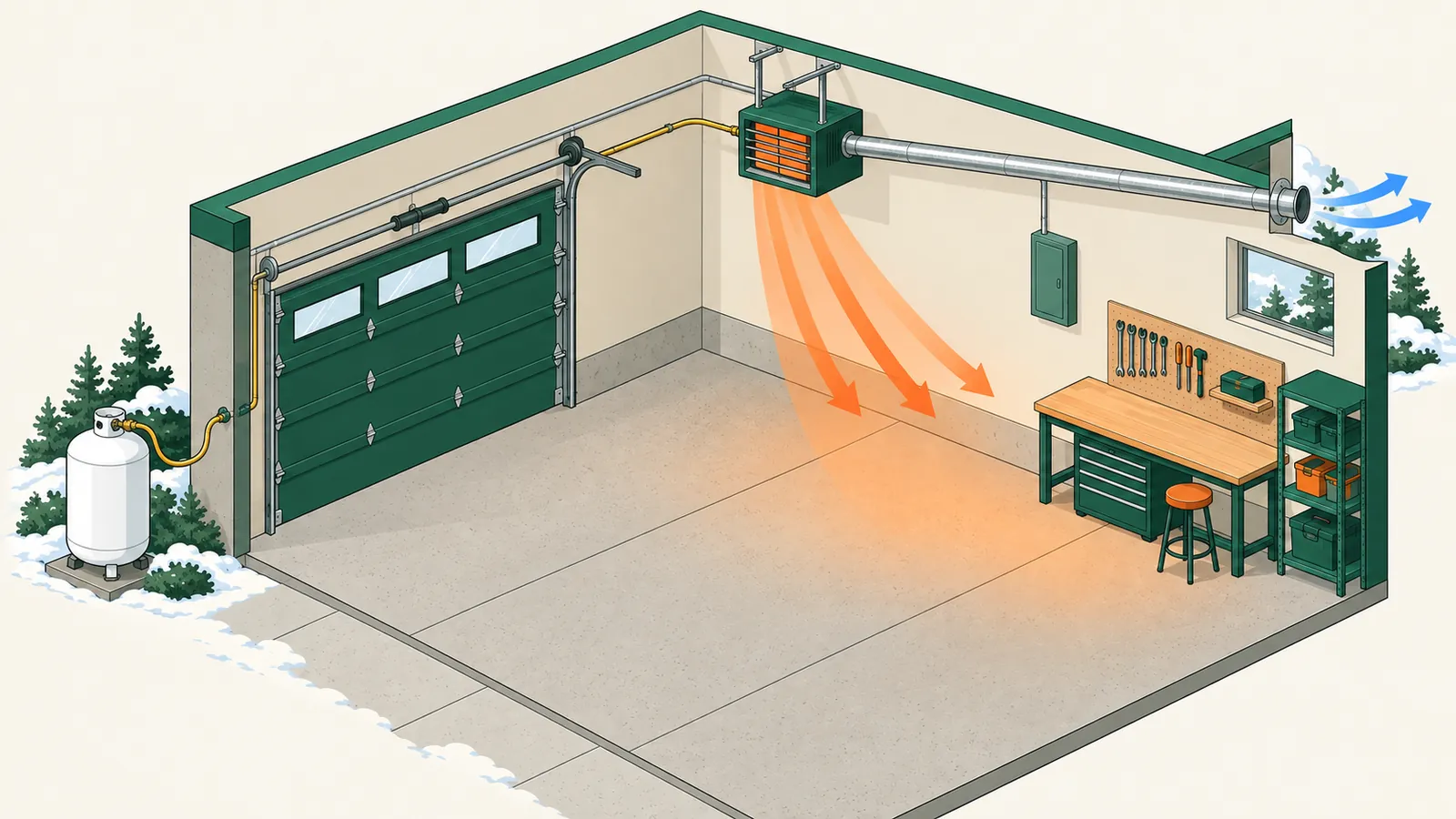
What size propane heater for your garage
Propane heaters are sold by input rating, the fuel they burn per hour. The heat that reaches your garage is lower. We assume 80% efficiency, so a 45,000 BTU/hr heater delivers about 36,000 BTU/hr. Size by the delivered number, then shop by the input number.
| Garage | Heat needed, average | Input, average | Input, poor insulation | Input, good insulation |
|---|---|---|---|---|
| 1-car, 12 × 20 ft | 10,000 BTU/hr | 30,000 | 30,000 | 30,000 |
| Compact 2-car, 20 × 20 ft | 17,000 BTU/hr | 30,000 | 45,000 | 30,000 |
| 2-car, 24 × 24 ft | 24,500 BTU/hr | 45,000 | 50,000 | 30,000 |
| 3-car, 32 × 24 ft | 32,500 BTU/hr | 45,000 | 75,000 | 45,000 |
The jumps are big because heaters come in steps. A 20 × 20 garage with average insulation fits a 30,000 BTU garage heater, but poor insulation pushes it to 45,000. A three-car garage sits at 45,000 with average insulation and needs 75,000 when the walls are bare, more than a 60,000 BTU heater can cover.
Ceiling height, a colder design low or a warmer target all raise the number. Use the calculator above with your own measurements, or open the full garage heater calculator to try different doors and windows.
Are propane heaters safe in a garage?
The heater type matters more than the fuel. A vented propane unit heater pulls in air, burns the fuel and sends the exhaust outside through a flue. Installed to the manual and kept clear of anything that burns, it is as routine as a gas furnace.
An unvented heater burns the same fuel but leaves the exhaust in the room. The EPA lists unvented gas space heaters as a source of carbon monoxide, nitrogen dioxide and particles indoors, and PNNL notes they also release a lot of water vapor. In a closed garage, that moisture lands on tools and cars as condensation.
Whatever you install, put CO alarms in the home. The CPSC recommends one on every level and outside sleeping areas, and lists the warning signs of poisoning: headache, dizziness, weakness, nausea, vomiting, sleepiness and confusion. Garage rules add one more: the model code requires a gas appliance's ignition source to sit at least 18 inches above the garage floor unless the heater is listed as resistant to igniting flammable vapors.
Vented or ventless?
Vented costs more up front. You pay for the vent kit, a wall or roof penetration and a qualified installer. In return you can run it all day with the garage closed.
Ventless heaters are cheap and need no flue, which is why they are popular for quick warm-ups. They need a source of fresh air while running, and several states and municipalities have banned unvented combustion appliances altogether. The ventless garage heater guide walks through the risks and the rules to check.
What decides it is the heater's listing, not how long you plan to run it. Use a heater only in the kind of space its label and manual allow, with the ventilation they require and within your local rules. For a closed garage you spend time in, a vented heater is the straightforward choice.
How much propane a garage heater burns
A gallon of propane holds 91,452 BTU. At full fire, a heater burns its input rating divided by that number every hour: about 0.33 gallons an hour for a 30,000 BTU heater and 0.49 for a 45,000. The old rule of thumb that a 100,000 BTU heater burns about a gallon an hour is close; the real figure is about 1.09.
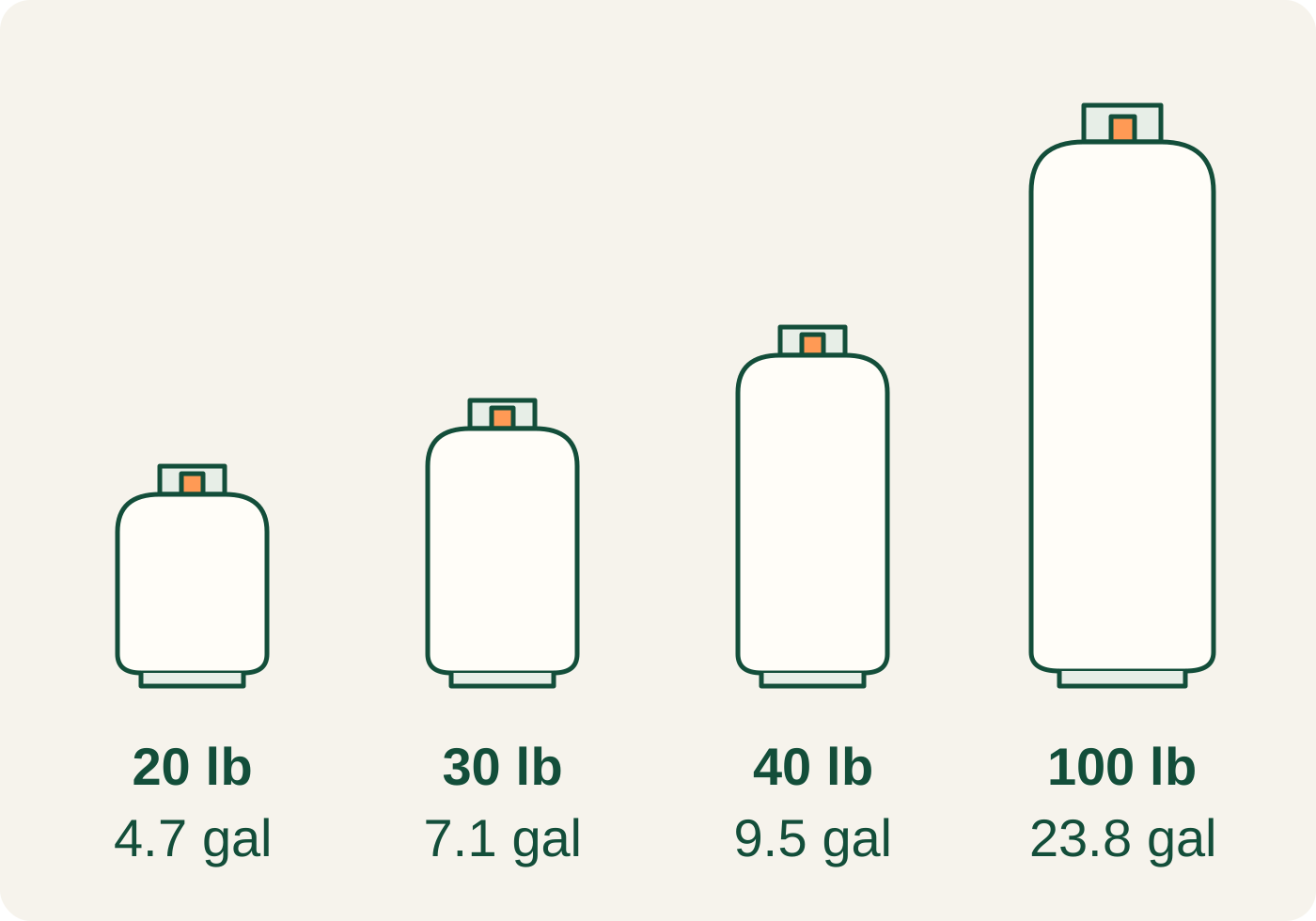
How long will the tank last?
A 20 lb tank (4.7 gal) runs a 30,000 BTU/hr heater for about 14 hours at full fire, or about 29 hours of garage time if the heater runs half the time.
Uses nominal tank capacity and 91,452 BTU per gallon. Real run time is usually shorter. NIST notes that most 20 lb exchange cylinders are filled to 15 lb, about three quarters of the fuel this assumes.
Small cylinders work for a portable heater and a short session. For a ceiling unit heating a two-car garage, a 100 lb cylinder lasts about 48 hours at full fire, which is a few weeks of evening use. Most people heating for a whole winter end up with a larger tank set by a propane supplier and a regular delivery.
Ceiling, wall, infrared or portable
Ceiling-hung unit heaters are the standard for whole-garage heat. A fan pushes warm air across the space, and the unit stays out of the way of cars and benches. Clearances to anything that can burn come from the heater's label and installation manual, and they differ by model and by direction, so mount it exactly as the manual shows.
Infrared tube heaters warm the floor, the cars and you rather than the air. They shine in tall garages and shops with drafty doors, where warm air would just escape or rise to the ceiling.
Wall heaters suit smaller garages and come in vented versions. Portable heaters that screw onto a cylinder are unvented, and many are approved for outdoor use only. Never use an outdoor-only heater inside a garage, even briefly or with the door open. Check the heater's listing and manual before it comes indoors.
Want a thermostat? Most vented unit heaters accept a wall thermostat, which keeps the garage at a steady temperature and stops the heater from running flat out between visits.
The most efficient propane garage heater
Efficiency is the share of the fuel's heat that ends up in your garage instead of going up the flue. Manufacturer data shows up to 83% thermal efficiency for standard power-vented unit heaters and up to 97% for condensing models, which pull extra heat out of the exhaust.
A condensing heater costs more and needs a drain for the water it condenses. In a garage heated a few hours a week, the fuel it saves may never cover that. In a shop heated all day, it can. This site assumes 80% for every gas and propane estimate, so a condensing heater will use a bit less fuel than our numbers show.
What propane costs to run in a garage
From October 2025 through March 2026, residential propane averaged $2.55 a gallon in EIA's weekly survey. At that price our default garage, heated 6 hours a day with the heater running half that time, costs about $77 a month. A one-car garage costs about $31 and a three-car about $102.
Per unit of heat, propane sits in the middle. A million delivered BTU costs about $34.90 with propane, $18.50 with natural gas and $50.70 with electric resistance at the 2025 averages we use. If natural gas runs to your street, the natural gas garage heater guide is worth a look.
Your own price will differ, especially with a leased tank or a summer fill. Put your price and hours into the cost to run a garage heater calculator for a number that matches your bill.
Propane garage heater questions
Are propane heaters safe for garages?
A vented propane unit heater, installed by a qualified installer and kept clear of combustibles, is a standard garage heater. Unvented models release carbon monoxide, nitrogen dioxide and water vapor into the space, so they need fresh air and a CO alarm, and some states and cities ban them. Read the ventless heater safety guide.
How many BTUs do I need to heat a 20x20 garage?
About 17,000 BTU/hr of delivered heat for a 20 × 20 × 8 ft garage with average insulation at a 40°F rise. In propane terms that is a 30,000 BTU/hr input heater. Poor insulation raises the need to 25,500 BTU/hr, which calls for a 45,000 BTU/hr unit.
What is the most efficient propane garage heater?
A condensing, vented unit heater. Manufacturer data shows up to 83% thermal efficiency for standard power-vented unit heaters and up to 97% for condensing ones. Condensing units cost more and need a condensate drain, so they pay off mainly in garages heated for long hours.
How long will a 20 lb propane tank last on a 30,000 BTU heater?
About 14 hours at full fire, using the tank's nominal 4.7 gallons. If the heater cycles and runs half the time, that stretches to about 29 hours of garage time. Many exchange tanks are filled to 15 lb, so expect roughly three quarters of those figures.
Do I need a vented propane heater in my garage?
For a heater you run for hours in a closed garage, yes, vented is the safe default. Vented units send their exhaust outside. Ventless units keep it in the room, and local codes in some places prohibit them altogether, so check with your building department first.
Sources
Checked October 1, 2026. Page dates are the publisher's own.
- EIA, British thermal units (Btu) (undated) · 91,452 Btu per gallon of propane
- EIA, weekly residential propane prices (October 2025–March 2026 weekly mean)
- Manchester Tank, portable DOT LPG cylinders catalog (11/2020) · nominal gallons at 60°F
- NIST, LPG 20 pound cylinders (2021)
- EPA, Sources of Combustion Products (Dec 17, 2025)
- PNNL Building America Solution Center, Unvented Combustion Appliances (undated)
- CPSC, Carbon Monoxide Information Center (undated)
- UpCodes, IRC 2024 Chapter 24 (G2408.2, G2444.4) (2024 IRC)
- Manufacturer data, power-vented unit heater (undated) · up to 83% thermal efficiency
- Manufacturer data, condensing unit heater (undated) · up to 97% thermal efficiency
Sizes and costs come from the same model as the garage heater calculator: 8 ft ceiling, 20°F outside, 60°F inside, 80% efficiency and the October 2025 to March 2026 average propane price. We do not recommend specific brands or models.