Electric Garage Heaters: Size, Wiring and Running Cost
Most two-car garages need about 7,200 W of electric heat, which one 7,500 W heater on a 240 V circuit covers. A one-car garage needs about 2,900 W. A 1,500 W plug-in heater can only warm a corner or a very small, tight space.
Those figures assume average insulation and a 40°F rise (20°F outside, 60°F inside). Change any of that in the calculator below.
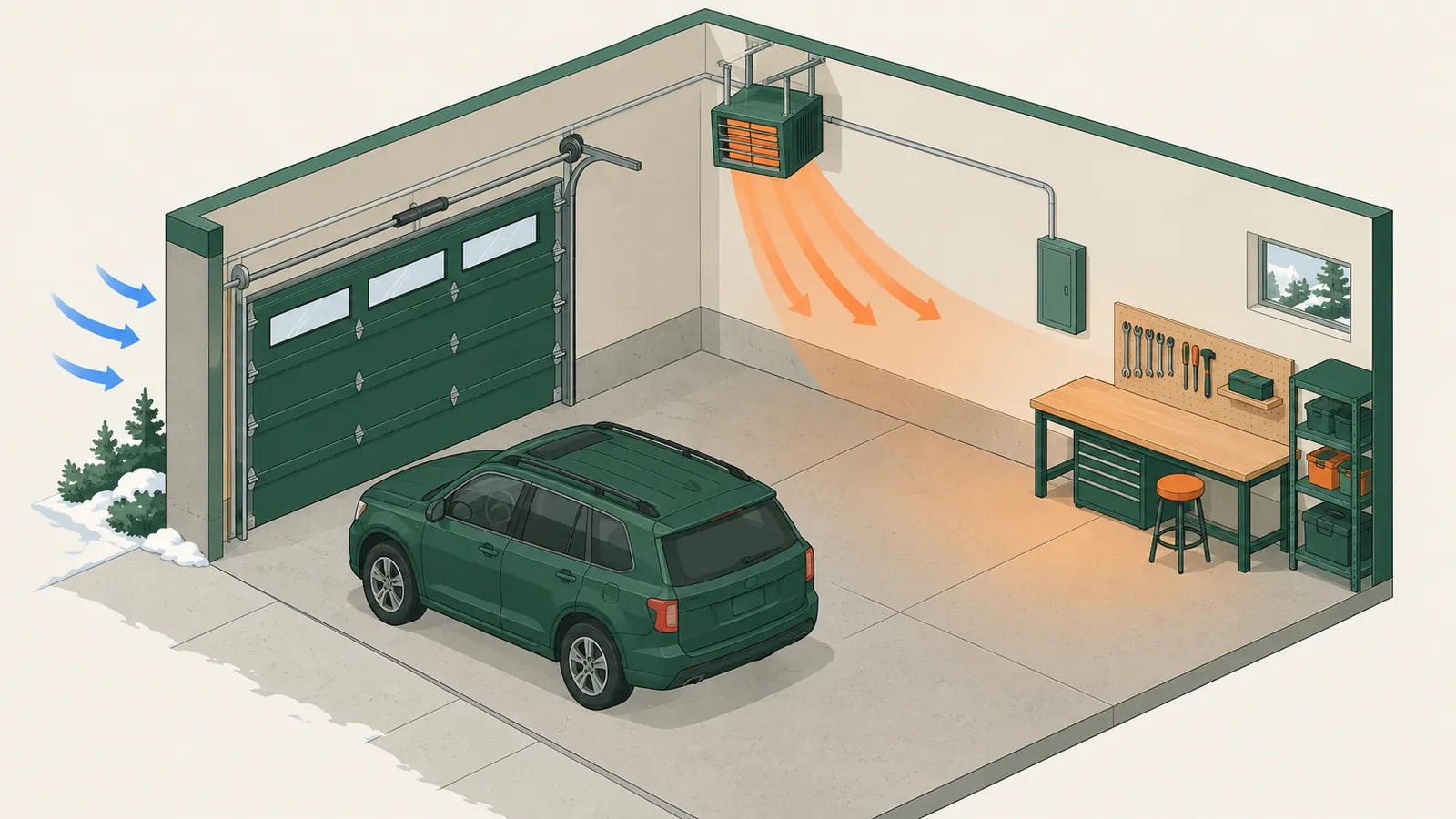
How many watts your garage needs
Heat need scales with the air you are warming and how fast the walls and door leak it. Here is what the calculator gives for three common garages at a 40°F rise, which is a 20°F day held at 60°F inside.
| Garage | Poor | Average | Good | Excellent |
|---|---|---|---|---|
| 1-car 12 × 20 × 8 ft | 4,500 W 5,000 W heater | 2,900 W 4,000 W heater | 2,200 W 4,000 W heater | 1,800 W 4,000 W heater |
| 2-car 24 × 24 × 8 ft | 10,800 W 2 × 6,000 W | 7,200 W 7,500 W heater | 5,400 W 6,000 W heater | 4,200 W 5,000 W heater |
| 3-car 32 × 24 × 8 ft | 14,400 W 2 × 7,500 W | 9,500 W 10,000 W heater | 7,200 W 7,500 W heater | 5,700 W 6,000 W heater |
Two things jump out. Insulation matters as much as size: a poorly insulated two-car garage needs more heat than a well-insulated three-car. And above about 10,000 W, one residential electric heater stops being enough. Our model splits the load into two units there.
Your garage will not match a row exactly. Taller ceilings, a colder design day or a warmer target all push the number up. The calculator above handles all of it.
When a 120V plug-in heater is enough
A standard plug-in space heater is rated 1,500 W, which makes about 5,118 BTU/hr. At 120 V it pulls about 12.5 A, most of a typical 15 A household circuit, so plug it straight into a wall outlet and keep other loads off that circuit.
That much heat covers about 120 sq ft of average garage on a 20°F day. In a well-insulated garage in mild weather it stretches to about 210 sq ft, and to about 270 sq ft if the space is finished and tight. Even a one-car garage needs about 2,900 W on a cold day, and 1,800 W when it is well insulated and the weather is mild.
So a plug-in heater is a spot heater. It is a good, cheap way to take the chill off where you stand, and many well-rated models cost under $100 according to Consumer Reports. It will not hold a cold two-car garage at working temperature.
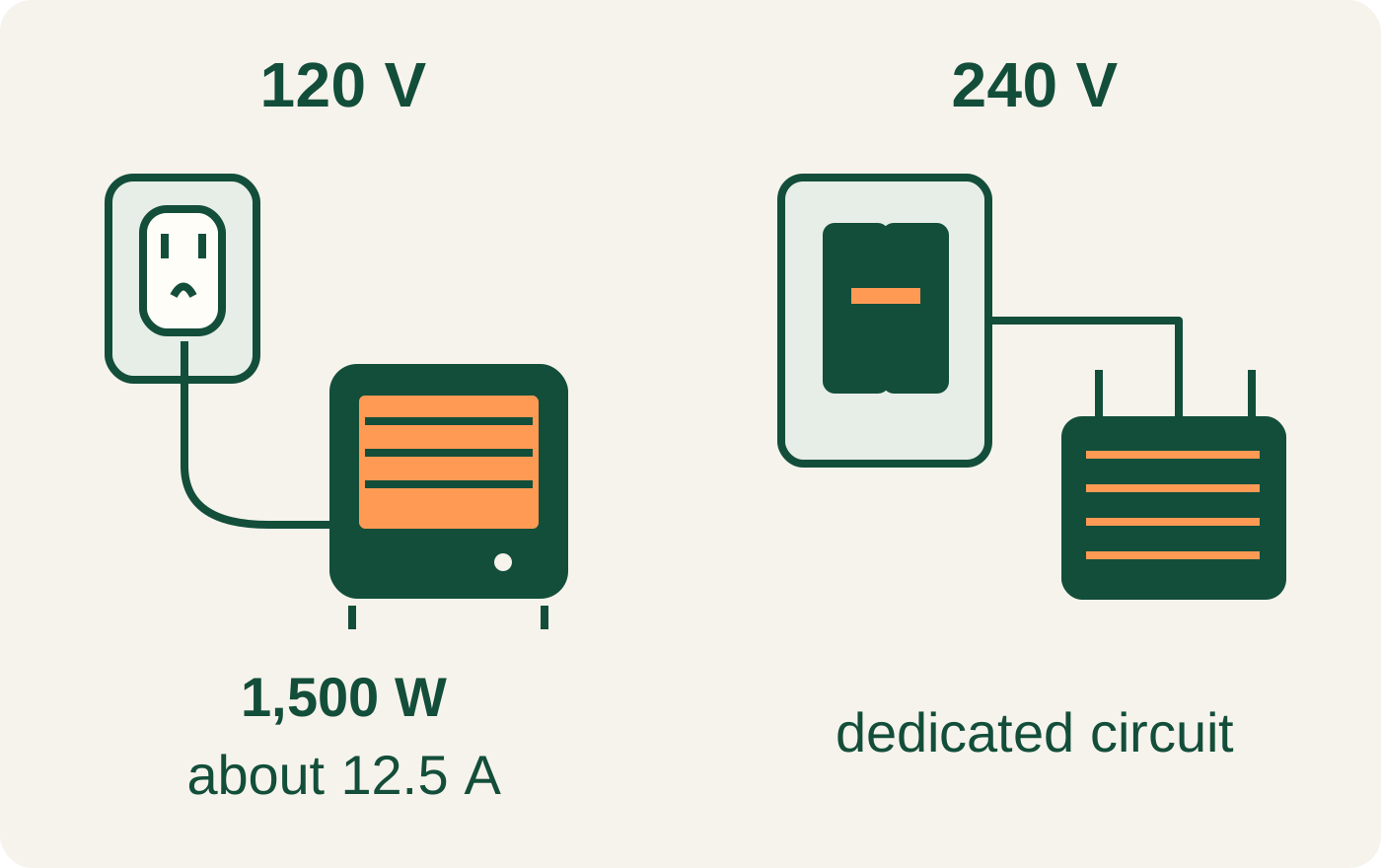
240V garage heaters: plug-in or hardwired
Whole-garage electric heat means a 240 V unit heater, usually 4,000 to 10,000 W. HomeAdvisor lists electric garage units at $150 to $1,000 before installation, and a new dedicated circuit at $570 to $1,000 (June 2026).
Some 240 V heaters ship with a cord and plug; others are hardwired to a disconnect or thermostat. A plug-in model needs a matching receptacle on a circuit sized for that heater. The plug type has to agree with the nameplate and the breaker, so let your electrician choose it rather than buying an adapter.
Hardwiring is the tidier option for a heater that stays put. It also lets you add a wall thermostat. Our garage heater installation cost page breaks down what each piece of that work typically costs.
Portable or fixed?
A portable heater suits a garage you use for an hour here and there, or a renter who cannot add wiring. Keep it at least 3 feet from anything that can burn, including rags, solvents and the car, and never run it on an extension cord or power strip (USFA).
A ceiling or wall-mounted heater is the better fit once you heat the garage often. It sits up out of the way, throws heat across the whole floor and runs on its own circuit. For a two-car garage that usually means one 7,500 W unit; a three-car garage at 9,500 W calls for a 10,000 W heater.
Forced air or infrared?
A forced-air heater warms the air and blows it around, so the whole garage comes up to temperature. It is the right pick for a space you want comfortable everywhere, like a workshop with tools on every wall.
Infrared heats people and surfaces in its line of sight, a bit like stepping into sunshine. It feels warm quickly and suits a bench or a gym corner. At equal watts it uses exactly the same electricity per hour as a fan heater; it just puts the heat where you are instead of into the air at the ceiling.
What circuit a 240V heater needs
The National Electrical Code treats fixed electric space heating as a load you size at 125%: the circuit conductors must handle at least 1.25 times the heater's current (NEC 424.4(B)). Here is that math for common sizes at 240 V.
| Heater | Draws | × 125% | Breaker example | More |
|---|---|---|---|---|
| 4,000 W | 16.7 A | 20.8 A | 25 A | — |
| 5,000 W | 20.8 A | 26.0 A | 30 A | 5,000 W details |
| 7,500 W | 31.3 A | 39.1 A | 40 A | 7,500 W details |
| 10,000 W | 41.7 A | 52.1 A | 60 A | 10,000 W details |
Before you buy, check that your panel has room for a double-pole breaker and enough spare capacity. A licensed electrician can confirm both, pull a permit where one is required and match the wire, breaker and receptacle to the heater's nameplate.
What an electric garage heater costs to run
Electric heat is simple to price: watts divided by 1,000 is kWh per hour at full power. At the 17.3¢/kWh 2025 U.S. average, here is what common sizes cost when they run half the time over 6 hours a day, every day.
| Heater | Per hour, full power | Per month | Cost per month |
|---|---|---|---|
| 1,500 W | $0.26 | 135 kWh | $23 |
| 4,000 W | $0.69 | 360 kWh | $62 |
| 5,000 W | $0.87 | 450 kWh | $78 |
| 7,500 W | $1.30 | 675 kWh | $117 |
| 10,000 W | $1.73 | 900 kWh | $156 |
Your bill depends on your rate, your hours and how often the thermostat calls for heat. Put your own numbers into the cost to run a garage heater tool, or start from your state's average on the electricity rates by state page.
The most efficient electric garage heater
They are all about the same. The Department of Energy notes that electric resistance heating is essentially 100% efficient at the point of use, because all the electricity it draws becomes heat. A pricey infrared panel and a basic fan heater of equal watts make the same heat per kWh.
Two things do cut the bill. A heat pump, such as a ductless mini split, moves heat instead of making it, and the DOE says it can deliver two to four times more heat than the electricity it uses. ENERGY STAR also lists garages as a good place for ductless systems. And insulation, especially an insulated door, shrinks the heater you need in the first place.
Why a thermostat matters in a garage
Without a thermostat, a heater runs flat out until you switch it off. With one, it cycles off once the garage reaches your setting, which is how the cost table above can assume heating only half the time.
Many unit heaters have a built-in thermostat on the housing. That works, but the heater is often mounted high where the air is warmest, so it can shut off early. A wall thermostat at working height reads the temperature where you are. It has to be rated for the heater's voltage and current, so it goes in with the wiring.
Electric or gas?
Per unit of heat delivered, electricity is the expensive fuel. At 2025 U.S. averages, a million BTU of heat costs about $50.70 with electric resistance, $34.90 with propane and $18.50 with natural gas.
Electric wins on everything else: no venting, no fuel line, no combustion in the garage and a much cheaper install. For a few hours a week that usually outweighs the higher rate. Our gas vs electric garage heater comparison runs both for your garage, and the best way to heat a garage guide ranks all six common options.
Electric garage heater questions
What is the most efficient electric heater for a garage?
Every electric resistance heater, fan or infrared, turns essentially all of its electricity into heat, so efficiency barely differs between models. The real savings come from a heat pump, which the U.S. Department of Energy says can deliver two to four times more heat than the electricity it uses, and from insulation that shrinks the load.
Do electric garage heaters use a lot of electricity?
Yes, compared with most appliances. A 7,500 W heater uses 7.5 kWh for every hour at full power, about $1.30 at the 17.3¢/kWh 2025 U.S. average. Running half the time for 6 hours a day, that is about 675 kWh and $117 a month.
What size heater for a 24x24 garage?
About 24,500 BTU/hr, or 7,200 W of electric heat, with an 8 ft ceiling, average insulation and a 40°F rise. A 7,500 W heater is the usual match. See the 2-car garage heater size guide.
How many square feet will a 7,500 watt garage heater heat?
About 600 sq ft with an 8 ft ceiling, average insulation and a 40°F rise. Good insulation stretches that to about 800 sq ft; a drafty, uninsulated garage drops it to about 400 sq ft. See the 7,500 W breakdown.
Can a 120V heater heat a 2-car garage?
Not in cold weather. A 24 x 24 garage needs about 7,200 W, and a 120 V plug-in heater gives 1,500 W. You would need about 5 of them, each on its own circuit. Use a 240 V heater for the whole space and keep the plug-in for a bench.
What breaker does a 7,500 W garage heater need?
At 240 V a 7,500 W heater draws about 31.3 A. The electrical code sizes the circuit for fixed space heating at 125% of the load, about 39 A, which points to a 40 A breaker. The heater's nameplate and your electrician have the final say. Circuit details for 7,500 W.
Sources
Checked October 1, 2026. Page dates are the publisher's own.
- DOE Energy Saver, Electric Resistance Heating (archived) (captured Jan 1, 2026)
- DOE Energy Saver, Air-Source Heat Pumps (archived) (captured Jan 1, 2026)
- ENERGY STAR, Ductless Heating & Cooling (undated)
- NEC 424.4(B) quoted by Fast Trax (code text)
- Cleveland State University, Portable space heaters (undated) · 1,500 W at 12.5 A
- USFA, Heating fire safety (undated)
- USFA, space heater pictograph (undated)
- Consumer Reports, Will using a space heater save you money? (Oct 12, 2025)
- HomeAdvisor, Garage Heater Installation Cost (June 19, 2026)
- HomeAdvisor, Cost to Install a Dedicated Circuit (June 19, 2026)
Every heater size and cost on this page comes from the same model as the garage heater calculator. Unless a section says otherwise: 8 ft ceiling, 20°F outside, 60°F inside, 17.3¢/kWh.