The Best Way to Heat a Garage, Ranked for Your Garage
At our reference prices, a vented natural gas unit heater has the lowest running cost: about $97 a winter for a 24 × 24 garage used 4 hours a day, 5 days a week. In the same example with no gas line at the garage, a 240 V electric heater costs less in total over three winters, because it is so much cheaper to install.
Put in your own garage below and the six options re-rank themselves.
Ranked for your garage
24,500 BTU/hr, 4 h a day, 5 days a week, heating half that time. Prices are the 2025 U.S. averages unless you change them in the calculator.
Ordered by fuel cost per winter.
- 1
Natural gas unit heater (vented)
$97 per winter
One 45,000 BTU/hr input unit
- Installed
- $1,500–$6,000New gas line and vent. Same model as our installation cost page.
- Install work
- Gas line, vent and a licensed installer
- Good for
- Long hours and big or cold garages
- Watch out
- Installation can cost more than years of fuel if there is no line nearby
- 2
Ductless mini split heat pump
$152 per winter
Check the model's output at your design low
- Installed
- $2,400–$5,500Single-zone installed range, HomeAdvisor, June 2026.
- Install work
- HVAC installer, outdoor unit and refrigerant lines
- Good for
- Garages you want to heat and cool year round
- Watch out
- Output drops in deep cold. Check the model's capacity at your design low
- 3
Propane unit heater (vented)
$183 per winter
One 45,000 BTU/hr input unit
- Installed
- $1,600–$7,000New tank setup and vent. Same model as our installation cost page.
- Install work
- Tank, regulator, line, vent and an installer
- Good for
- Homes without natural gas that heat for long hours
- Watch out
- Fuel costs more than natural gas, and the tank needs deliveries
- 4
240 V electric unit heater
$266 per winter
One 7,500 W unit covers it
- Installed
- $750–$2,250New 240 V circuit. Same model as our installation cost page.
- Install work
- Electrician and a dedicated 240 V circuit
- Good for
- Small to mid garages, short sessions, no gas
- Watch out
- Highest running cost per BTU at average U.S. prices
- 5
Electric infrared heater
$266 per winter
One 7,500 W unit covers it
- Installed
- $1,000–$2,500New 240 V circuit. Same model as our installation cost page.
- Install work
- Electrician and a 240 V circuit, mounted high
- Good for
- Warming people at a bench instead of all the air
- Watch out
- Same electricity per hour as any resistance heater at equal watts
- –
120 V plug-in heater
$266 per winter
Too small: about 5 plug-in heaters
- Installed
- —5 units: get an installation quote. Our model prices a single installation.
- Install work
- None. Plugs into a wall outlet
- Good for
- A workbench corner or a small, tight garage
- Watch out
- 1,500 W is about 5,100 BTU/hr, too little for most whole garages
Mini split cost uses the COP you enter. The default 1.75 is an editable example: it is the minimum NEEP requires at 5°F and maximum output for its cold-climate list, not a seasonal average. Your model's real winter COP can be higher or lower. Ventless heaters are left out of the ranking. Why ventless heaters are left out.
The cheapest way to heat a garage
On running cost alone, natural gas wins by a wide margin. Our default garage needs 24,500 BTU/hr. Heated 4 hours a day, 5 days a week for a 5-month winter, that is about $97 on gas, $152 with a mini split, $183 on propane and $266 on electric resistance heat.
Installation flips the picture when gas is not already at the garage. Add three winters of fuel to the installed cost and a 240 V electric heater lands at $1,549 to $3,049. Gas with a new line lands at $1,791 to $6,291. If a gas line is already there, gas drops to $1,291 to $4,291. Using the middle of each range, it then pays back its extra installation cost over ten winters at about 12 heated hours a week, or over three winters at about 39.
The answer changes when your prices do. Electricity runs well above the national average in some states, and propane prices swing with the season. Plug your own rates into the cost to run a garage heater page if your bill looks nothing like the average.
The best way to heat a garage with electricity
For a whole garage, a hardwired 240 V unit heater is the workhorse. Our default garage needs about 7,200 W, which a single 7,500 W heater covers on a 40 A circuit. A 120 V plug-in heater tops out at 1,500 W, about 5,100 BTU/hr. That is fine for a bench corner or a small, tight garage, and too little for most two-car garages in winter.
A ductless mini split is the efficient electric option. At the example COP of 1.75 we use (an editable assumption), it costs about $152 a winter against $266 for resistance heat, but it costs $2,400 to $5,500 installed. The electric garage heater guide covers watts, circuits and 120 V versus 240 V in detail.
The best way to heat a garage with natural gas
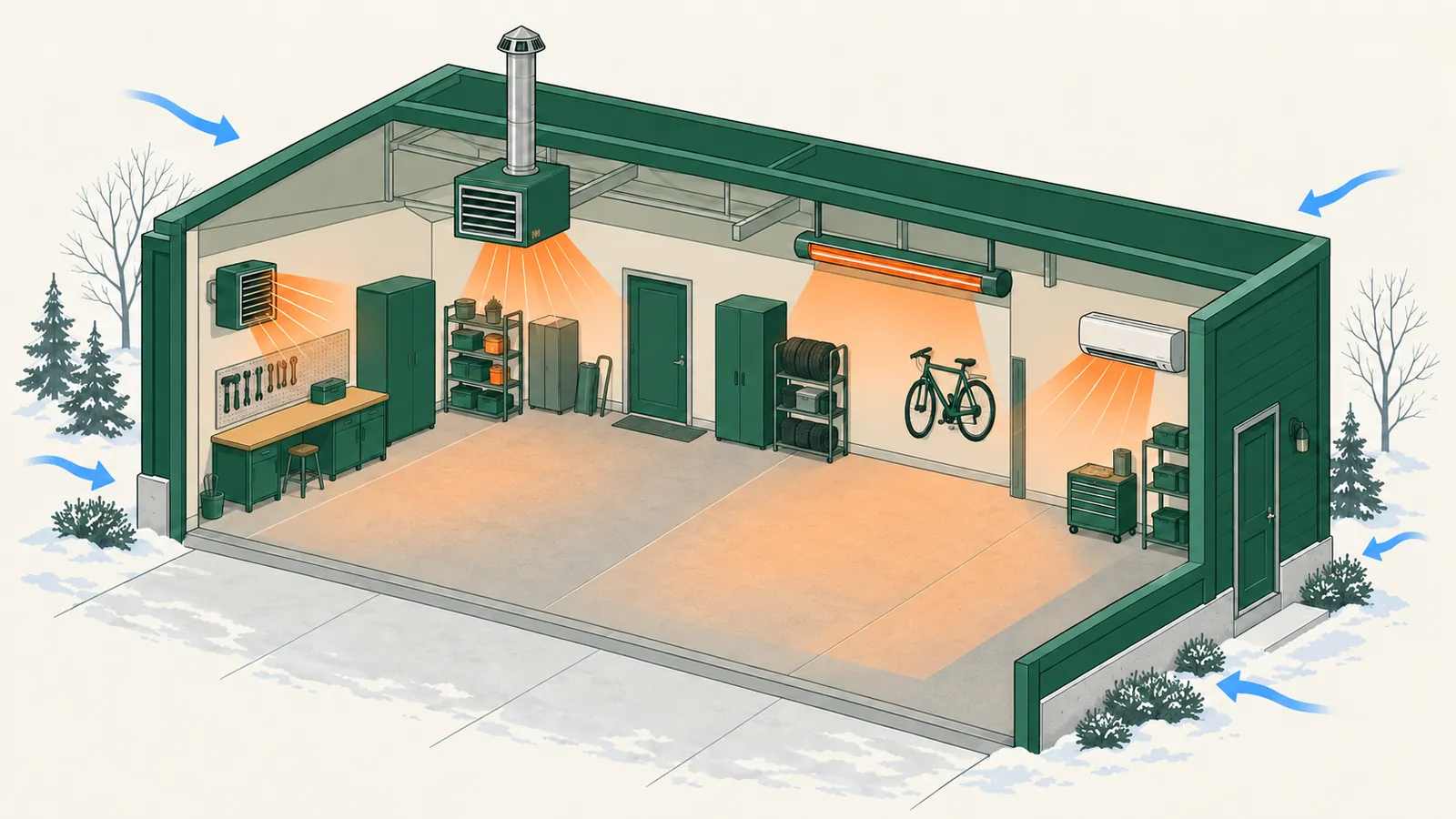
A vented gas unit heater hung from the ceiling is the usual answer. It blows warm air through the whole space, vents its exhaust outside and runs for about a third of the cost of electric heat per BTU at average prices. Our default garage calls for a 45,000 BTU/hr input unit.
Gas infrared tube heaters make sense in tall garages and shops where you work in one area. They warm people and the floor directly, so the space can feel comfortable at a lower air temperature. The natural gas garage heater guide covers sizing, venting and gas line work.
How to heat a garage without a heater
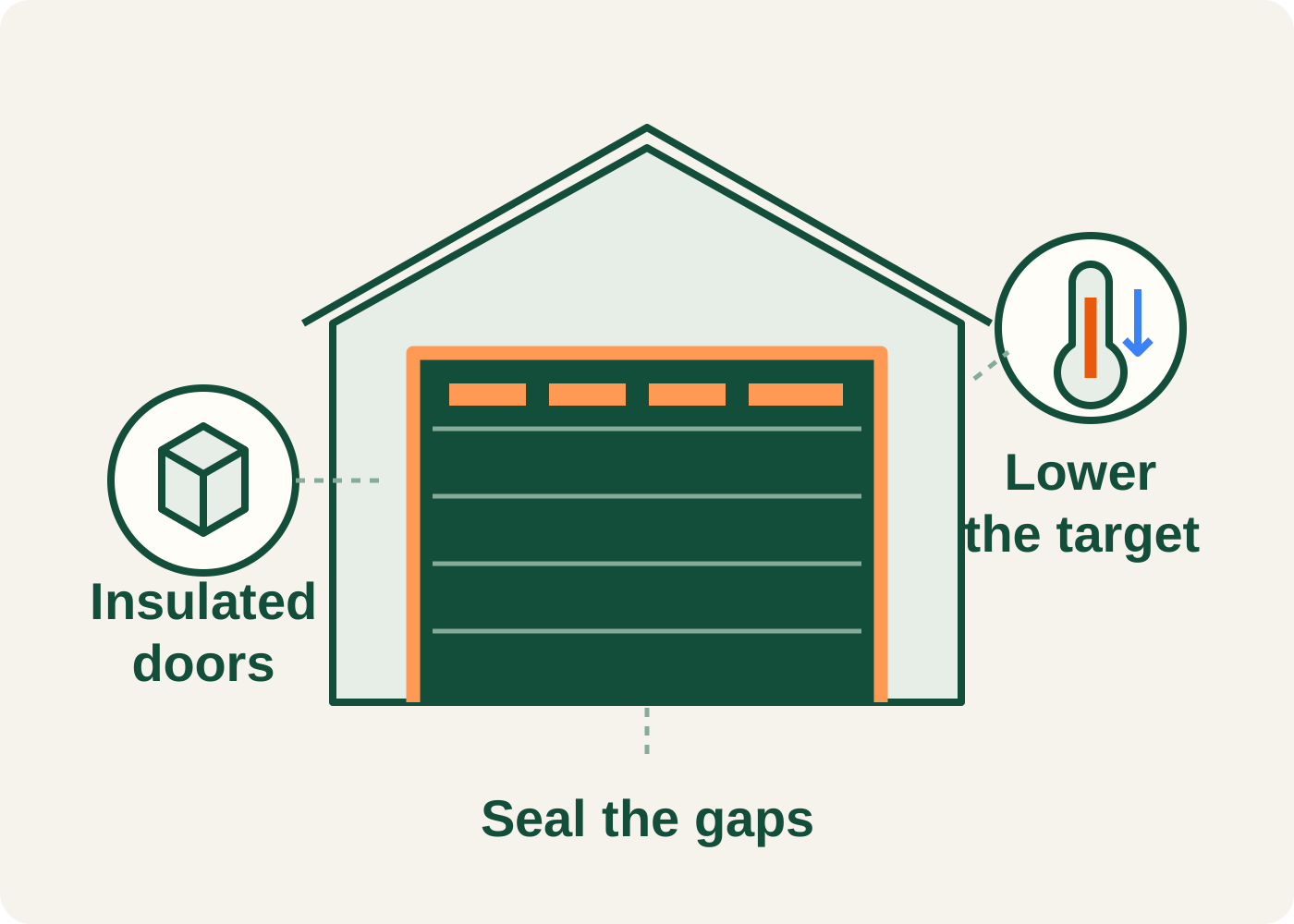
You cannot make heat from nothing, but you can need a lot less of it. In our model, insulated garage doors cut the default garage from 24,500 to 21,000 BTU/hr, about 14% less. Sealing air leaks around the doors and walls is worth about 12%. Holding 55°F instead of 60°F saves about 12%.
Those cuts shrink every heater option and every bill. On electric heat, insulated doors save about $38 a winter in our default case. Use the garage heater calculator and its Compare an upgrade panel to price the change against your own garage.
Free heat helps at the margins. Open the door on sunny afternoons, keep it shut on windy days and park a car that has just been driven inside. None of these will hold a cold garage at working temperature, but each one takes the edge off.
Heat and cool your garage with one system
A ductless mini split is the only common garage heater that also cools. ENERGY STAR specifically lists garages and other outbuildings as a good fit for ductless systems, since there are no ducts to extend.
The limit is deep cold. Heat pump efficiency and often output fall as the outdoor temperature drops; NREL gives the example of a COP of 2.5 at 32°F falling to 1.5 at 0°F. If your design low is near or below 0°F, check the model's rated heating output at that temperature before you count on it as your only heat.
Other ways people heat garages
Radiant floor heat
Tubing set into a concrete slab can give very even, comfortable heat. It is usually practical only when a new slab is being poured, and it warms up slowly, so it suits garages that stay heated all winter.
Wood stoves
Insurers summarizing the NFPA 211 standard say solid-fuel appliances should not be installed in garages or anywhere gasoline vapors are present. Check with your local code official and your insurer before you consider one.
Kerosene and diesel heaters
Unvented kerosene heaters release carbon monoxide, nitrogen dioxide and particles into the room, according to the EPA. They are a poor choice for a closed garage you spend time in.
Extending the house heat
The model residential code (IRC R302.5.2) says ducts in a garage must be sheet steel and have no openings into the garage. In practice that rules out adding a register from the house system in most places. Ask your local building department before you plan on it.
The best choice for how you use the garage
Workshop, now and then. At 55°F for 4 hours twice a week, gas costs about $34 a winter and electric about $93. The gap is too small to pay for a gas line, so electric is the better buy.
Workshop, most days. At 60°F for 8 hours, 5 days a week, gas drops to $194 against $532 for electric. Saving about $338 a winter, gas pays back its extra installation cost in a few winters when a line is already close to the garage.
Home gym. Short, warm sessions (62°F, 2 hours, 4 days) cost about $111 a winter on electric. Electric or electric infrared is the simple choice.
Storage or frost guard. Holding 40°F around the clock is a long-hours job: about $416 a winter on gas and $1,141 on electric in our default garage. Gas, or better insulation first, pays off fastest here.
Safety checklist
- Keep anything that can burn at least 3 feet from any heater, and plug portable heaters straight into a wall outlet, never an extension cord (USFA).
- Put a CO alarm in the home with any fuel-burning heater, and know the symptoms: headache, dizziness, weakness, nausea and confusion (CPSC).
- Gas appliances in a garage need their ignition source at least 18 inches above the floor unless they are listed as flammable-vapor-ignition resistant (IRC G2408.2).
- Have a licensed electrician add circuits and a qualified gas installer run gas lines and vents. Follow the heater's installation manual for clearances.
Questions about heating a garage
What is the most economical way to heat a garage?
Per hour of heat, natural gas. At 2025 U.S. average prices our default two-car garage costs about $97 a winter on gas, $183 on propane and $266 on electric resistance heat. Counting installation, electric often wins for garages you only heat now and then.
What is the most affordable way to heat a garage?
If you mean lowest upfront cost, a 240 V electric unit heater on a new circuit, about $750 to $2,250 installed in our model. A 1,500 W plug-in heater costs less still, but it only makes about 5,100 BTU/hr, which suits a workbench, not a whole cold garage.
What is the best way to heat an unheated garage?
Start with the doors. In our model, insulated doors cut the default garage's heat need from 24,500 to 21,000 BTU/hr. Then size a heater to what is left: electric for short sessions, vented gas for long hours.
What is the most effective way to heat a garage?
A forced-air unit heater sized to the whole space warms it fastest and most evenly. Infrared is the better tool when you only need to warm yourself at a bench, because it heats people and surfaces rather than all the air.
Is it cheaper to heat a garage with gas or electric?
Gas is cheaper to run. Electric is cheaper to install. Over three winters in our default case, electric totals $1,549 to $3,049 and gas with a new line totals $1,791 to $6,291. Compare gas vs electric for your garage.
Is a mini split good for heating a garage?
It can be, especially if you also want cooling. ENERGY STAR names garages as a good fit for ductless systems. Check the model's heating output at your coldest temperature, because heat pump output and efficiency drop as it gets colder.
Is it safe to use a propane heater in a garage?
A vented propane unit heater, installed to the manufacturer's instructions, is a normal garage heater. Unvented propane heaters release carbon monoxide and water vapor into the space, so they need fresh air and a CO alarm, and some places restrict them. Read the ventless heater safety guide.
Sources
Checked October 1, 2026. Page dates are the publisher's own.
- NEEP Cold Climate Air Source Heat Pump Specification v4.0 (effective Jan 1, 2023) · COP at 5°F of at least 1.75
- NREL, Air-Source Heat Pumps in Cold Climates (July 2025)
- ENERGY STAR, Ductless Heating & Cooling (undated)
- HomeAdvisor, Ductless Heat Pump Cost (June 20, 2026) · single-zone installed range
- Consumer Reports, space heater prices (Oct 12, 2025)
- EPA, Sources of Combustion Products (Dec 17, 2025)
- UpCodes, IRC R302.5 dwelling and garage openings (IRC text)
- Grinnell Mutual, Safety Guidelines for Solid-Fuel Burning Appliances (GMRC 1163, 5-19) · insurer summary of NFPA 211
- USFA, Heating fire safety (undated)
- CPSC, Carbon Monoxide Information Center (undated)
- UpCodes, IRC 2024 Chapter 24 (G2408.2) (2024 IRC)
Every size and cost on this page comes from the same model as the garage heater calculator. Unless a section says otherwise: 24 × 24 × 8 ft, average insulation, 20°F outside, 60°F inside, 2025 U.S. average prices.