Garage Condensation Calculator
Will your tools sweat when you turn on the heat? Enter this morning's weather and your heater to see the dew point, and the minute steel starts to get wet.
Your morning in the garage
Your tools will sweat
The heater is the water source. Use electric or vented heat, or open the garage far more than is comfortable. Never run an unvented heater in a closed garage.
- Water added in 4 hours
- 9.1 lb (1.1 gal)
- Outdoor dew point
- 12°F
- First water on steel
- 14 min
- Air changes to stay dry
- 5.3 per hour
Four hours of air, steel and dew point
The shaded stretch is when steel sits below the dew point and collects water. Estimates assume well-mixed air and do not model carbon monoxide. Read about ventless heater safety.
Is my garage floor about to sweat?
A warm, damp day after a cold spell is when slabs turn wet. Dew point is the temperature where the air starts to leave water behind.
Outdoor dew point is 49°F. That is above your floor temperature, so expect water. Keep the door closed until the air outside dries out, then run a fan.
Why heating a cold garage can make it wetter
Water condenses on any surface colder than the dew point of the air touching it. Air warms in minutes, while a vise or a table saw top takes hours. Add water to that warm air and you get a stretch where your best tools are the coldest thing in the room.
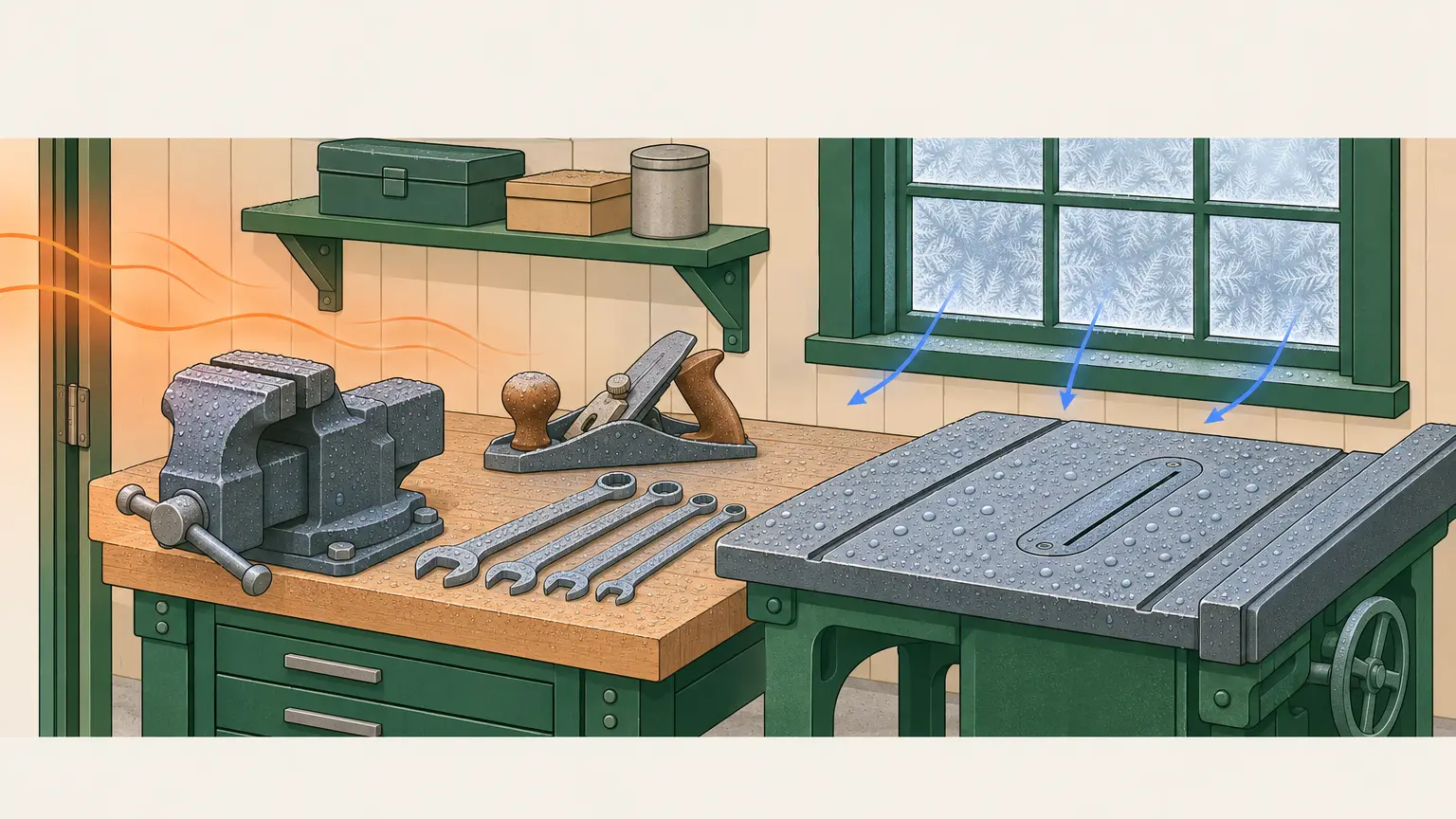
Burning fuel makes water. A ventless heater releases all of it into the garage. With the default example, the peak dew point is about 48°F with ventless propane and 12°F with electric heat, on the same morning.
Safety first: this tool looks at moisture only. Unvented heaters also release carbon monoxide. It does not tell you a heater is safe to run. Read the ventless heater safety guide and use a CO alarm.
How the calculation works
Dew point uses the Alduchov and Eskridge form of the Magnus equation. Moisture is a simple balance: water added by the heater and the car, less what escapes with air changes. Water per BTU comes from each fuel's chemistry. Steel warms toward the air on a lag that you choose, from 30 minutes for hand tools to 3 hours for a table saw top.
The result is a planning estimate, and it assumes the air is evenly mixed. Corners, shelves near the door and tools on a cold slab can run colder than the model.
Questions people ask
Why do my tools rust after I heat the garage?
Cold steel sits below the dew point of the air around it, so water condenses on it. In our default example, a 30,000 BTU ventless propane heater lifts the garage dew point to about 48°F while steel at 25°F warms slowly. The same morning with electric heat stays dry.
How much water does a propane heater put in the air?
About 0.75 lb for every 10,000 BTU burned, or roughly 2.3 lb an hour from a 30,000 BTU ventless heater. That is close to a quart of water every hour.
Does an electric garage heater cause condensation?
No. Electric and properly vented heaters add no water to the air. Warm air can still reach cold steel, but the amount of water in the air stays the same, and in winter that air is usually dry.
Why is my garage floor wet in spring?
A warm, damp day can bring air with a dew point above your cold slab. Water then forms on the concrete. Keep the door closed during that weather and ventilate once the outdoor air dries out.
What is a good dew point for a garage?
Keep the dew point at least 5°F below your coldest tools. For example, air at 60°F and 50% humidity has a dew point of about 41°F, so steel colder than that will collect water.
Will a dehumidifier stop garage condensation?
It can help in mild weather, but most units stop working well below about 60°F. In winter, removing the water source and warming steel slowly does more.
Sources
Sources last checked October 31, 2026.
- Relative humidity and dew point formulas (Alduchov and Eskridge constants), University of Miami (accessed October 2026)
- EPA: Sources of combustion products (December 17, 2025)
- PNNL Building America Solution Center: Unvented combustion appliances (accessed October 2026)