How Long Does It Take to Heat a Garage?
The air warms in minutes. The concrete takes a day. See both for your garage, and settle the keep-it-warm argument with numbers.
Your garage
When the air hits target, the floor is still about 29°F. You will feel the cold from below for hours.
- This heater delivers
- 36,000 BTU/hr
- Real heat loss at 60°F
- 14,186 BTU/hr
- Size to buy, with margin
- 24,500 BTU/hr
- Floor settles at
- 53°F
Air and floor temperature over 30 hours
Hover or tap the chart to read any moment. Estimates from a two-part model of air and slab, not a measurement of your garage.
Heat only when you use it, or keep it warm?
| Strategy | Per week | Wait each session | Floor at the start |
|---|---|---|---|
| Heat only when you use it | $3.06 | 59 min | 28°F |
| Hold 45°F, then warm up | $28.179× more | 26 min | 41°F |
| Hold 60°F all week | $44.0914× more | None | 53°F |
Assumes this outdoor temperature all week, at U.S. average energy prices. Between sessions an unheated garage settles at the "Garage now" temperature. Work out the cost to run a garage heater with your own rates.
Why the air and the floor run on different clocks
Most sizing tools answer one question: how much heat holds the garage at temperature once everything has warmed up. They say nothing about the first few hours. In that window the heater fights two things at once: heat escaping through the shell, and a cold slab soaking up everything it can.
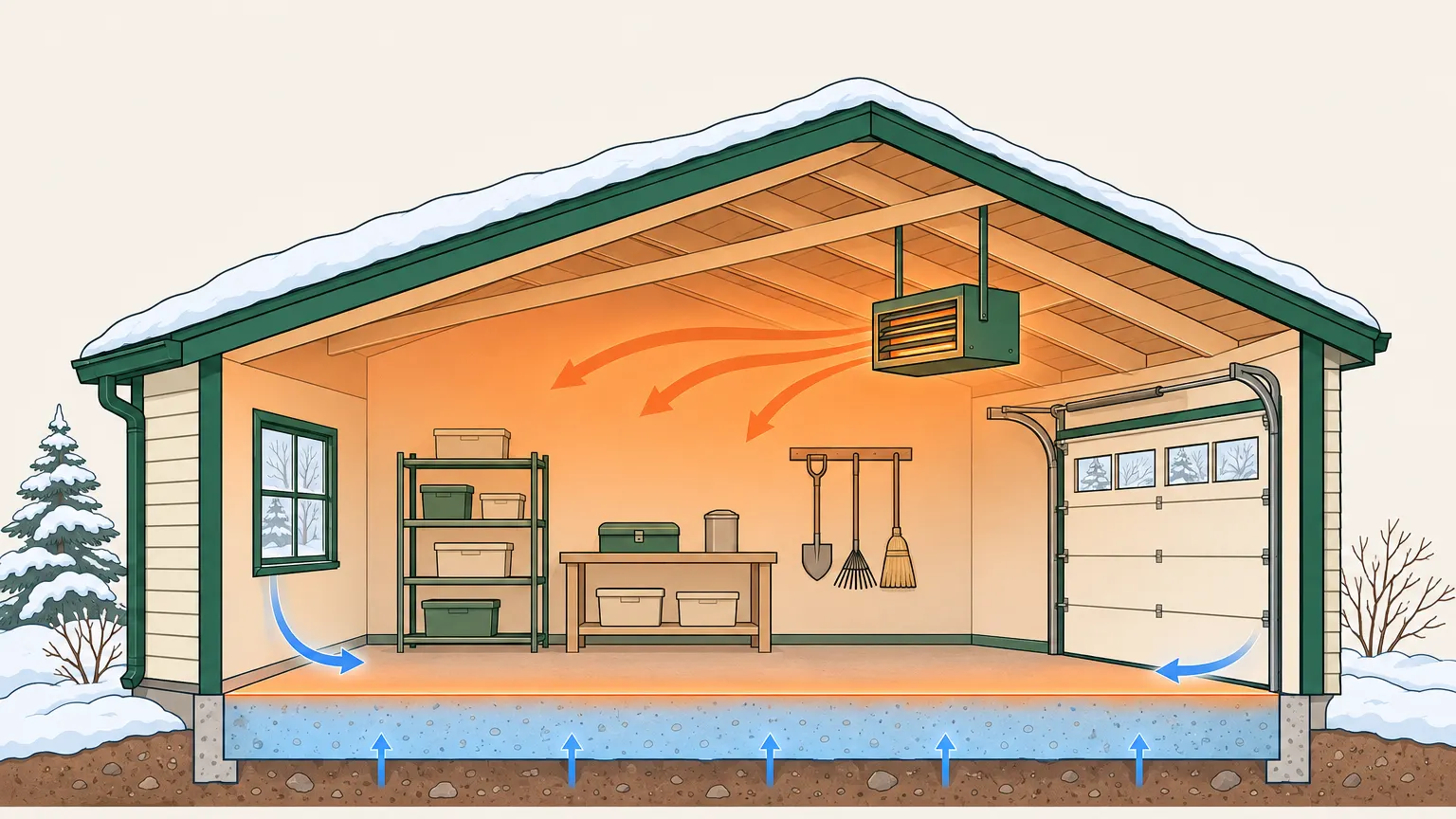
This is why a heater can feel weak on a cold morning and fine by the afternoon. It also explains why the air can read 60°F while your feet are still freezing.
How the simulator works
The model has two parts that exchange heat minute by minute: the air with light contents, and a 4-inch slab. Heat loss comes from assumed R-values and air leaks for each surface. The slab holds 28 BTU per cubic foot per °F, based on a density of 133 lb/ft³ and specific heat of 0.21 BTU/lb·°F. Air passes heat to the floor through an effective film of R-1.2 plus half the slab.
The garage heater calculator answers a different question: what size to buy. It adds a margin of about 1.7 times for the coldest mornings, drafts and a sensible warm-up. This simulator leaves that margin out to show what should really happen, which is why its heat loss reads lower. We compared it with warm-up times that owners report online, and it lands in the same range. Those reports are informal, so treat this as a sense check rather than a test.
Treat the results as a planning estimate. Real slabs also lean on the ground below, and a garage attached to a house stays warmer between sessions. Set "Garage now" to what your thermometer really shows.
Questions people ask
How long does it take to heat a 2-car garage?
In our model, a 24 × 24 garage with average insulation goes from 28°F to 60°F in about 38 minutes with a 60,000 BTU gas heater and about 60 minutes with a 45,000 BTU heater, on a 20°F day. A heater near the bare minimum can take hours.
Why is my garage floor still cold after the heater has been on for hours?
Concrete stores a lot of heat. A two-car slab absorbs about 5,400 BTU for each degree it warms, and warm air passes heat into it slowly. In our default garage the slab is only about 29°F when the air first reaches 60°F, and takes roughly a day to settle.
Is it cheaper to keep a garage warm or heat it when you need it?
Heating on demand costs less, because a warm garage loses heat all week. With two 3-hour sessions on a steady 20°F, holding 60°F costs about $44 a week against about $3 on demand in our model. Holding a temperature buys comfort and a warmer floor, not savings.
Does a bigger heater warm the floor faster?
Only a little. A bigger heater gets the air up much sooner, but heat still moves into concrete slowly. Radiant heaters help more, because they warm the floor directly.
Why is the heat loss here lower than the size the calculator recommends?
They answer different questions. The sizing number includes a margin so the heater copes with the coldest mornings and warms the garage in reasonable time. The simulator shows the plain heat loss, which is what the heater has to replace once things settle.
How long should I turn on my garage heater before I start working?
Run the simulator with your garage and heater. For a heater with plenty of spare capacity, 30 to 60 minutes usually gets the air there. If you lie on the floor or work with adhesives, start far earlier, or use mats to stay off the cold slab.
Sources
Sources last checked October 31, 2026.
- EIA electricity prices (2025 annual average)
- EIA natural gas prices (2025 annual average)
- EIA weekly propane prices (October 2025–March 2026 weekly mean)